iZotope & Boris FX Photon: A New Era of AI Audio Separation

AI-powered audio separation has come a long way, and the latest collaboration between iZotope and Boris FX is another impressive step forward.
Their first-ever collaboration, Photon, combines the expertise of two industry-leading audio and visual technology companies into a powerful new stem separation and audio enhancement tool.
I recently had the opportunity to test an advance copy of Photon, and after spending some time with its different algorithms, I wanted to share my experience and explain why I think this software could be especially useful for music producers, audio engineers, and content creators.
Disclosure: iZotope and Boris FX provided me with early access to Photon for review purposes. All opinions and observations expressed in this article are my own and reflect my personal experience using the software.
What Is Izotope Photon?
Photon is an AI-powered audio separation and enhancement application available as both standalone software and an ARA plug-in for compatible digital audio workstations.
For this review, I focused exclusively on the standalone application.
The concept is straightforward: import an audio file, select an AI model, and use Photon to isolate, remove, or rebalance individual elements of the recording.
Whether you're working with a finished song, a drum break, or dialogue recorded in a noisy environment, Photon provides several specialized algorithms designed for different situations.
The interface is refreshingly simple. You can visually separate stems, adjust their individual volumes, solo or mute specific elements, and export the results without navigating complicated menus.
Separating a Full Song
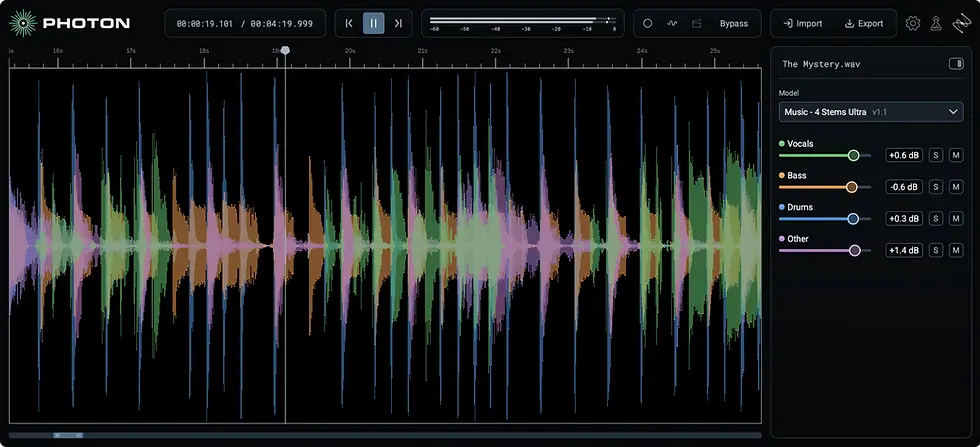
For my first demonstration, I loaded up "Hit Play," a track featuring Emcee Graffiti from our collaborative EP, Served Up.
The song contains vocals, prominent drums, heavy bass, and additional instrumentation, making it a good test for Photon's music separation capabilities.
Once the initial processing finished, I could independently adjust the vocals, drums, bass, and other musical elements.
The results were impressive.
The drums came through relatively clean, and being able to remove or reduce certain elements from an already mixed song opens up plenty of creative possibilities.
There are still some limitations. Soloing the vocals revealed audible artifacts, and the bass separation occasionally contained elements from other stems.
That's something worth emphasizing: AI stem separation isn't the same as having access to the original multitrack recording.
However, for producers looking to manipulate samples, remove drums, or isolate specific instrumentation, Photon offers a remarkably convenient workflow.
Cleaning Up Noisy Dialogue
Next, I tested Photon's audio enhancement capabilities using a recording of a reporter speaking outdoors in extremely windy conditions.
I initially selected the Outdoor Wind algorithm, which uses a simple strength control to reduce background noise while emphasizing the voice.
The difference was immediately noticeable.
While some artifacts remained, the processed recording was substantially clearer than the original.
Interestingly, I also tested the same recording using the Voice 2 Stems algorithm and actually preferred the results.
The voice sounded more natural, with fewer noticeable artifacts in certain frequencies.
This highlights something important I discovered while testing Photon: don't limit yourself to the algorithm that seems most appropriate for your recording.
Different models process audio differently, and experimenting with alternatives can sometimes produce better results.
Breaking Down Drum Loops
As someone who's been producing hip-hop for more than 25 years, this was probably one of my favorite demonstrations.
I imported a stereo drum loop from my sample library and selected Photon's drum separation algorithm.
The software allowed me to isolate and adjust individual drum components, including:
Kick
Snare
Toms
Hi-hats
Cymbals
Having this level of control over a finished stereo drum loop is something I could only dream about when I started making beats.
For sample-based producers, the possibilities are substantial.
Imagine finding a great drum break but wanting to reduce the hi-hats, remove a snare, or emphasize the kick before chopping it into your sampler.
Photon makes those adjustments possible without needing the original individual drum recordings.
The separation wasn't entirely artifact-free, but the overall quality was impressive, especially considering how quickly the software processed the audio.
More Than Just Music Production
Photon also includes specialized models for dialogue restoration and environmental noise reduction.
One particularly interesting feature is its Voice Separator, which can separate up to six individual voices.
For podcasters, interviewers, and video creators, this could be extremely useful.
If multiple people are speaking over one another, having the ability to isolate individual speakers could make editing and balancing dialogue considerably easier.
Photon includes 12 different models, covering applications such as indoor and outdoor recordings, traffic noise, wind, drum separation, and voice processing.
Each model also carries its own version number, suggesting room for continued improvements as the technology develops.
My Final Thoughts
I've used iZotope RX for years, particularly when working with samples and separating elements from existing recordings.
What immediately stood out to me about Photon was its simplicity.
The standalone interface is intuitive, the processing is straightforward, and the results across several different applications were consistently impressive.
Is it perfect? No.
Artifacts are still part of the equation, particularly when isolating individual elements from complex recordings.
But the technology has reached a point where producers and engineers can manipulate finished audio in ways that would have seemed almost impossible not that long ago.
For anyone working with samples, restoring dialogue, producing podcasts, or editing audio for video, Photon is absolutely worth checking out.
A big thank-you to the teams at iZotope and Boris FX for providing early access to the software.
Watch my full Photon demonstration on YouTube to hear the before-and-after examples and see the software in action.


Comments